Cera Care: Bringing communication and actions into one place.
Communication between Cera's branches, carers and families was spread across multiple systems. Requests raised through Freshdesk sat outside the Digital Care Platform, conversations weren't connected to client records, and families had little visibility once they'd submitted something.
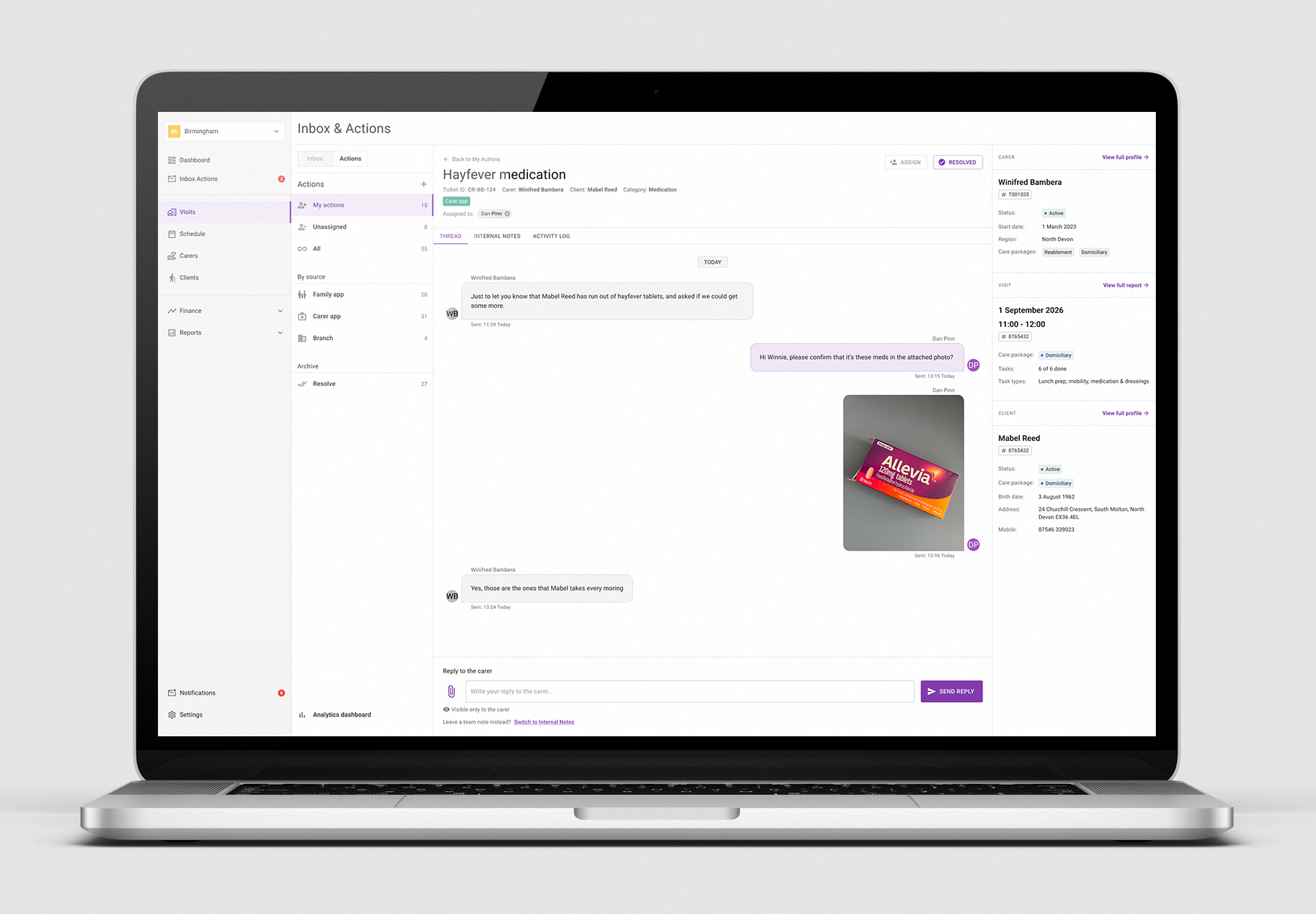
Working closely with Product and Engineering, I designed Inbox & Actions, a new experience spanning DCP, the Carer App and Family App.
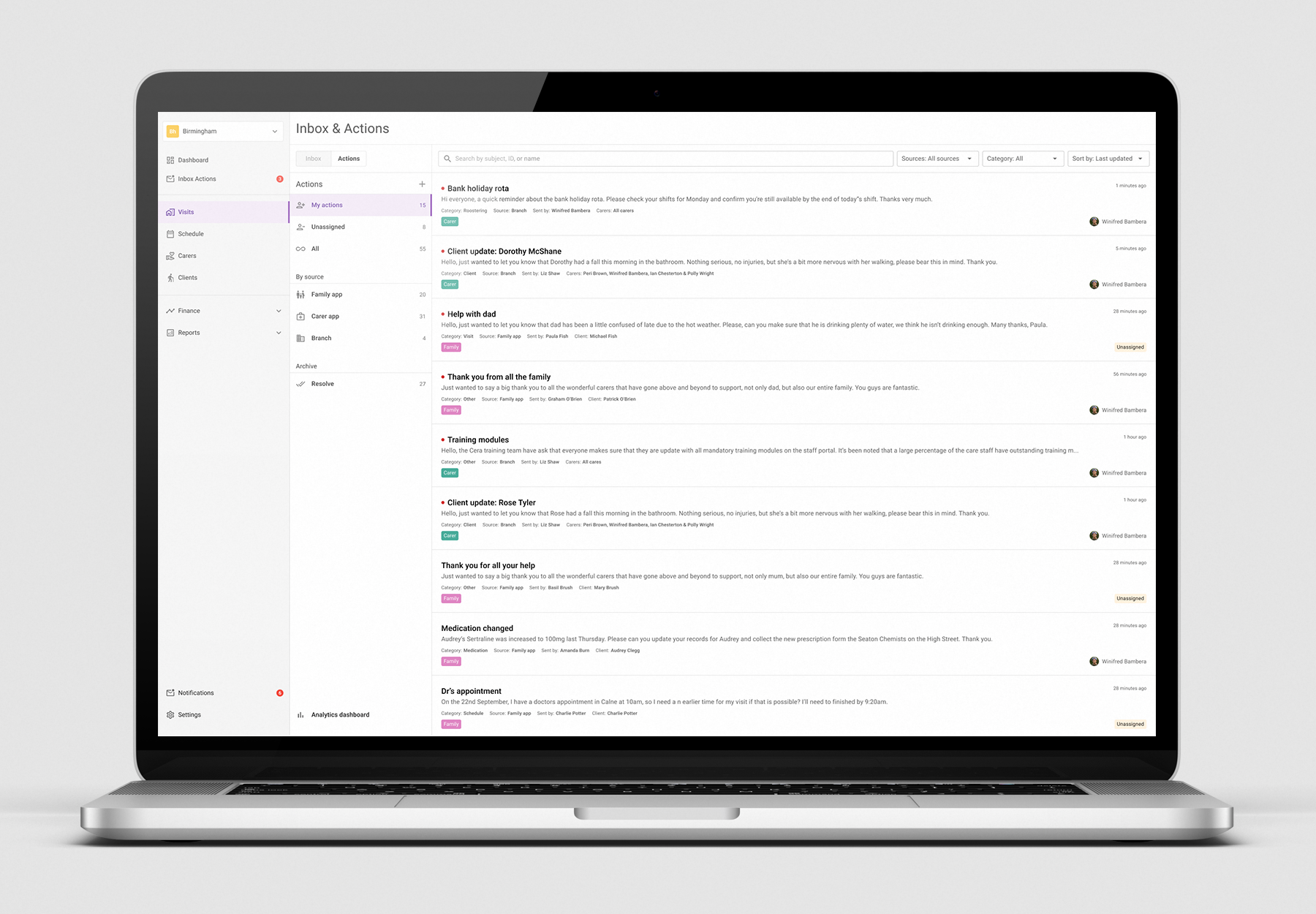
Rather than simply recreating Freshdesk, we used the opportunity to rethink how requests should work inside Cera. Each enquiry became an actionable piece of work that could be categorised, assigned, discussed, tracked and resolved, with the complete history linked back to the person receiving care.
Before designing the replacement, I carried out extensive interviews with branch staff to understand how Freshdesk was actually being used and where the biggest frustrations existed.
The research quickly showed that the problem wasn't simply the functionality Freshdesk provided. It was how disconnected it felt from the rest of a branch's day-to-day work.
Four themes consistently emerged:
1 Too many disconnected systems: Freshdesk was another third-party tool sitting outside Cera's Digital Care Platform. Branch staff regularly switched between different systems simply to understand and respond to a request.
2 Difficult to navigate: Users found Freshdesk unintuitive and harder to use than it needed to be. Finding the right information and keeping track of conversations added unnecessary friction to already busy workflows.
3 Important messages were easy to miss: Requests from carers and family members competed for attention within the existing system, making it too easy for something important to disappear amongst other messages.
4 The experience broke when users needed it most: Carers and families could begin an enquiry inside the Cera apps, but subsequent communication moved to email. This didn't match their expectations. Having started a conversation inside the app, users naturally expected it to stay there.
That became one of the strongest principles for the project: Start in the app. Stay in the app.
This aligned with the wider product principle that the complete request and conversation should remain within Cera's products until the issue was resolved.
Understanding the Problem
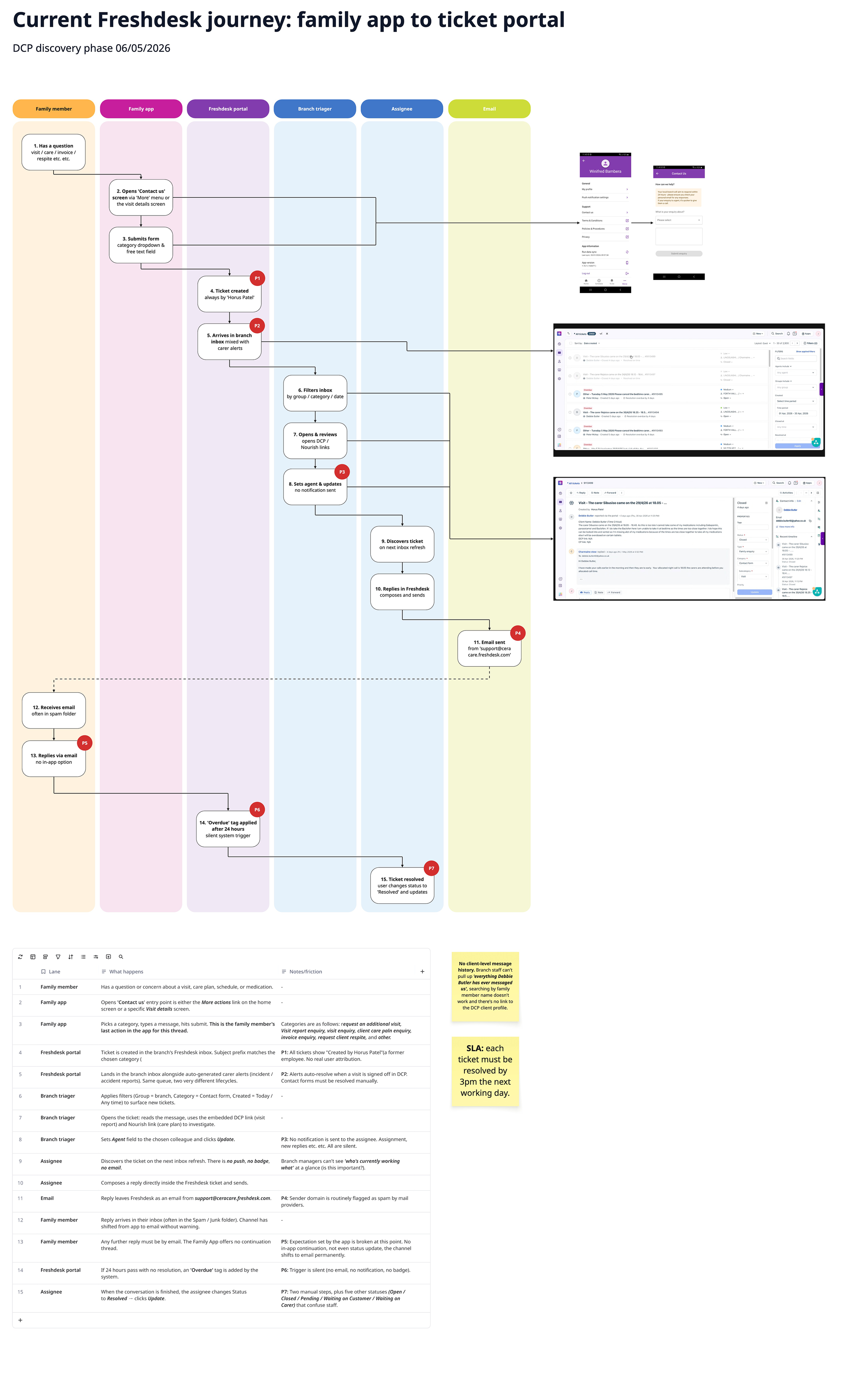
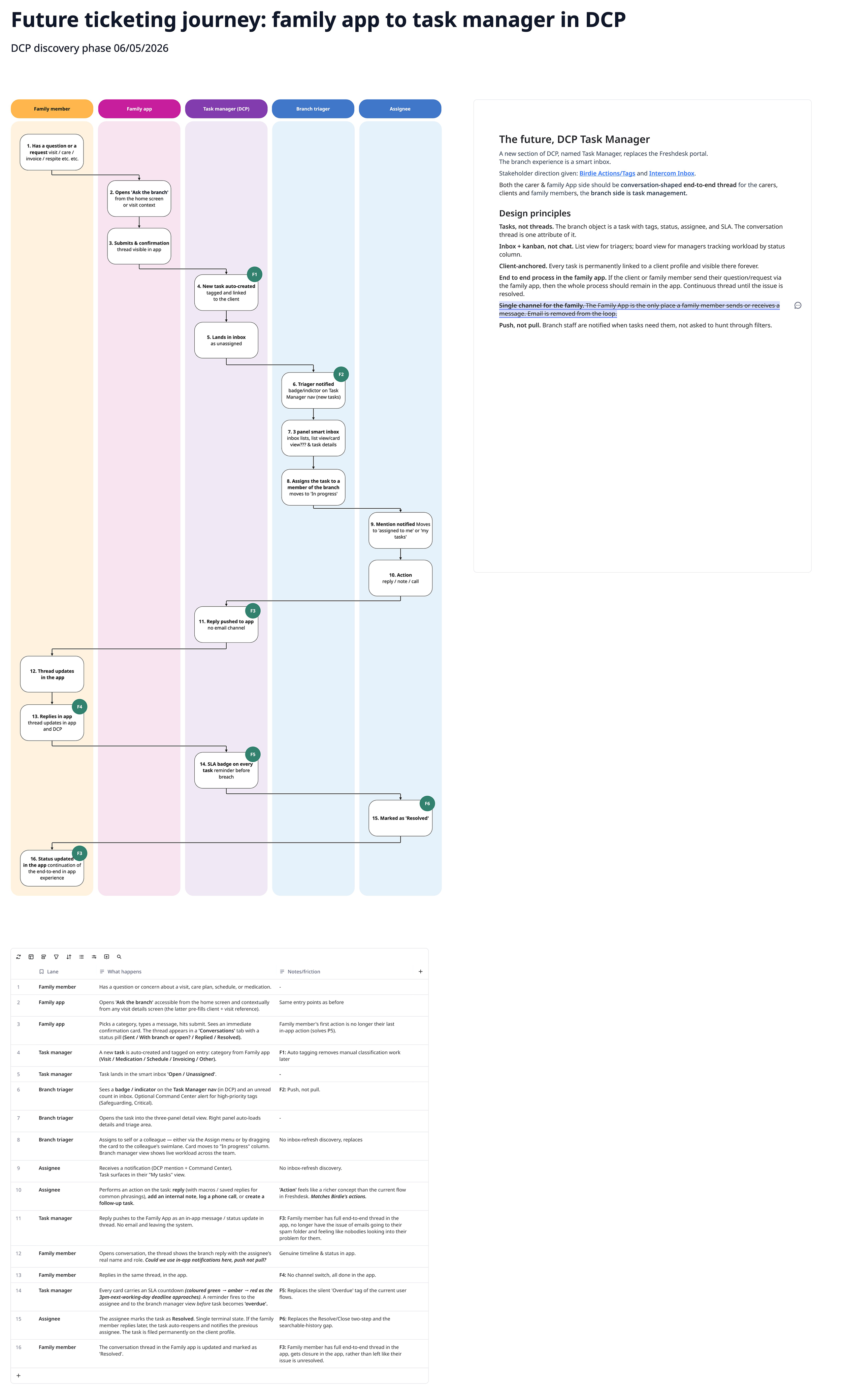
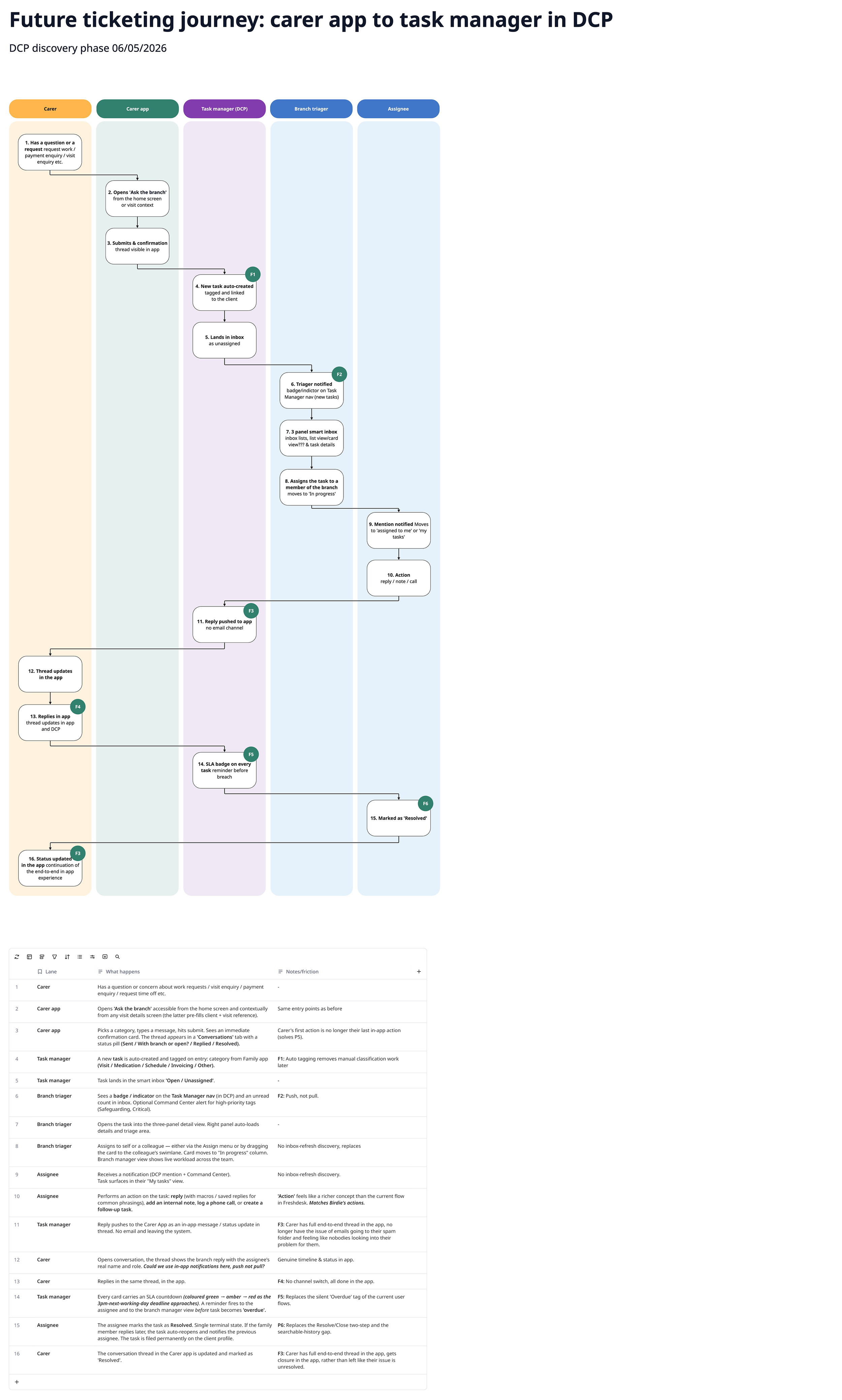
The interviews also helped us recognise that we weren't simply designing another messaging tool.
A family member might have a question about medication. A carer might need their hours changed. A branch team might need to investigate something and involve several colleagues before responding.
These were pieces of work that required ownership and resolution.
That led to another core principle: Tasks, not threads.
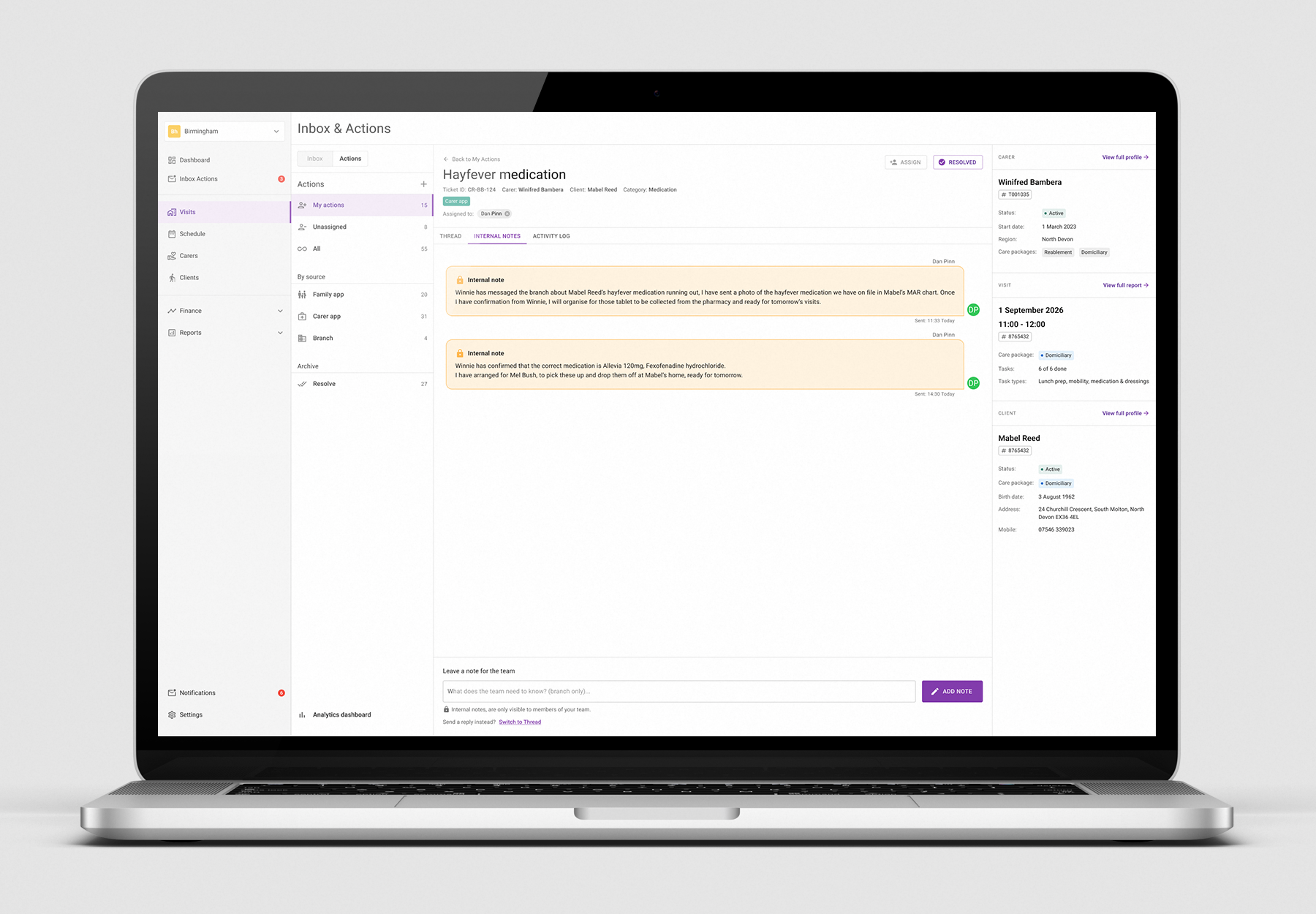
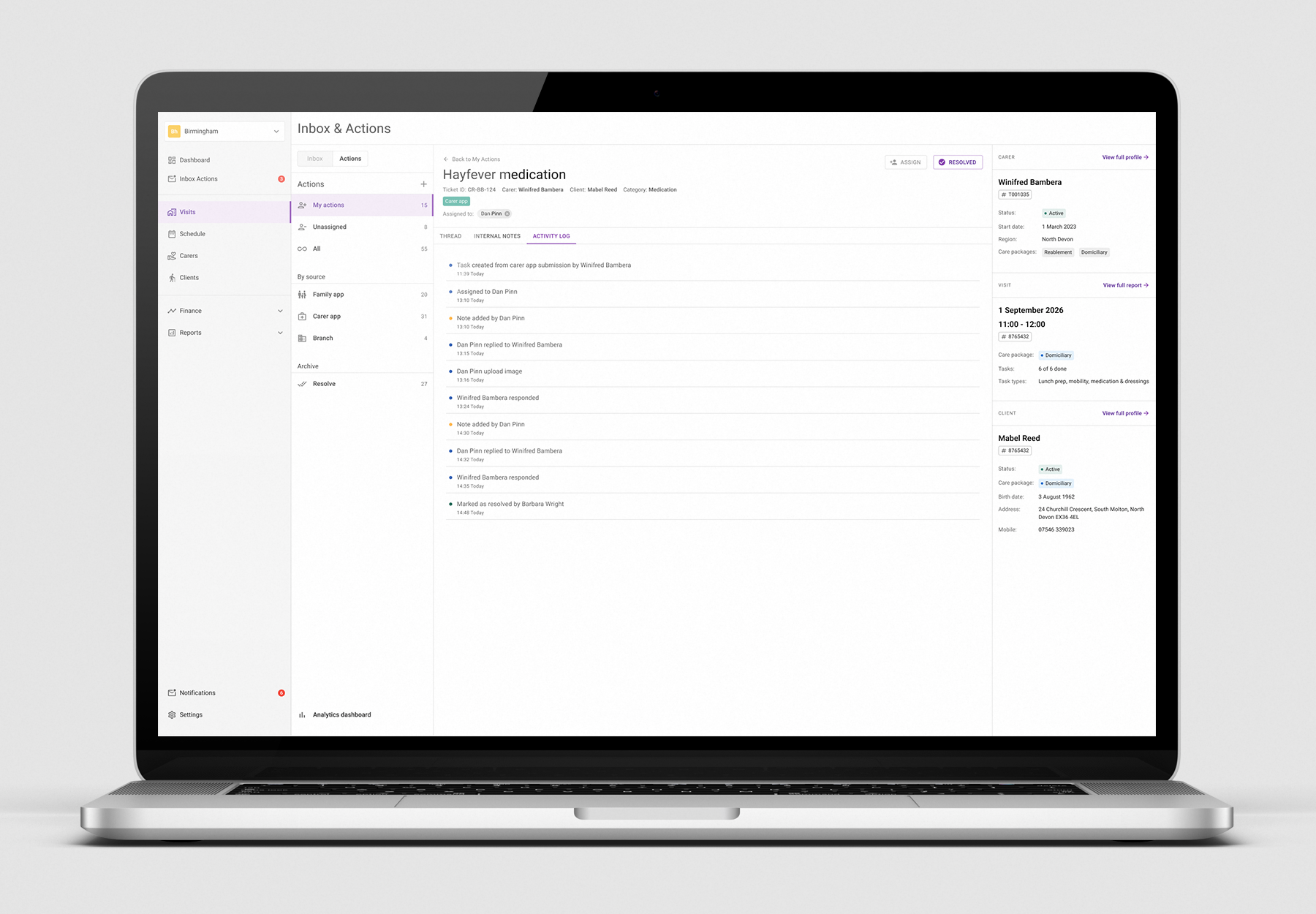
The conversation became one part of an action rather than the action itself. Each request could have a category, owner, status, SLA and audit history, while remaining permanently connected to the relevant client.
This gave us the foundation for Inbox & Actions and helped shift the project from recreating Freshdesk towards designing something specifically around the needs of Cera's branch teams.
Turning Research Into a Product Model
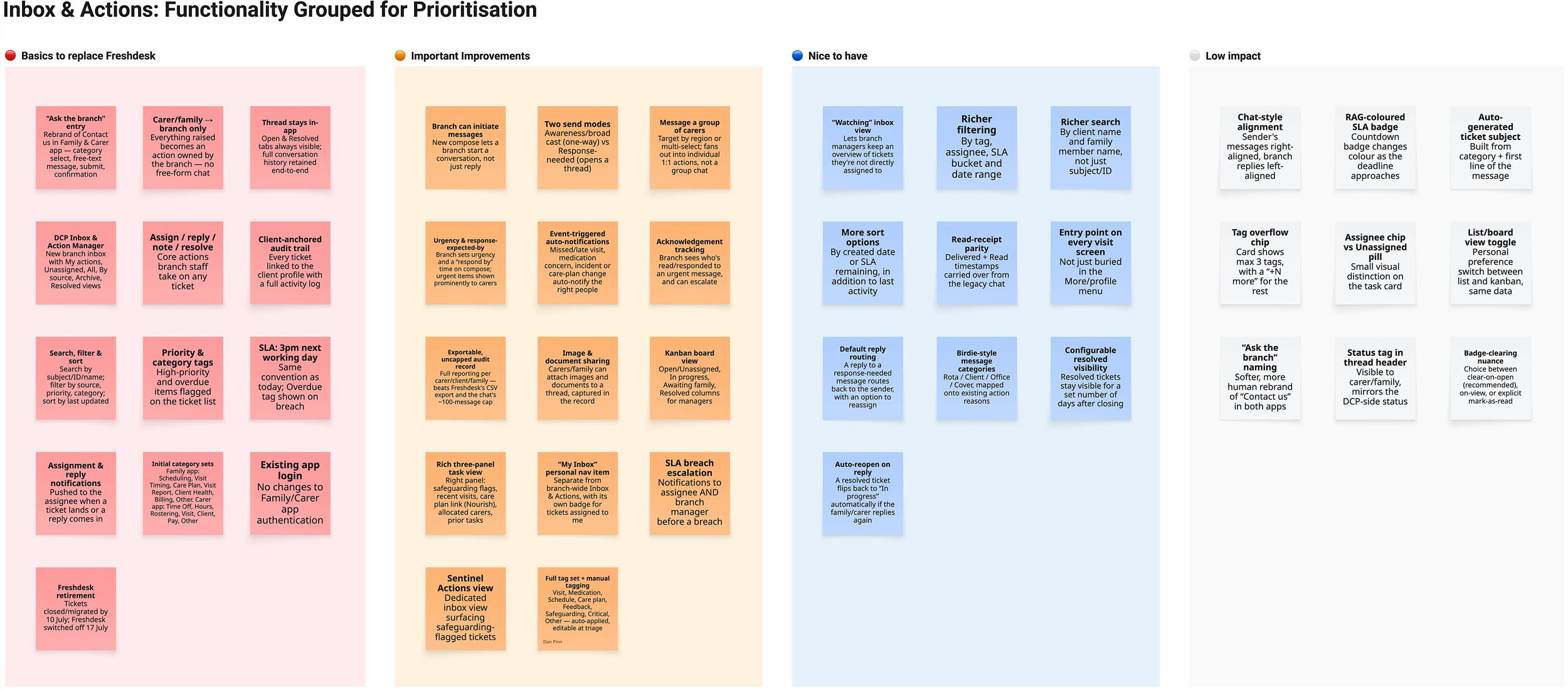
With a fixed deadline created by the end of Cera's Freshdesk contract, the first release deliberately focused on the core journey.
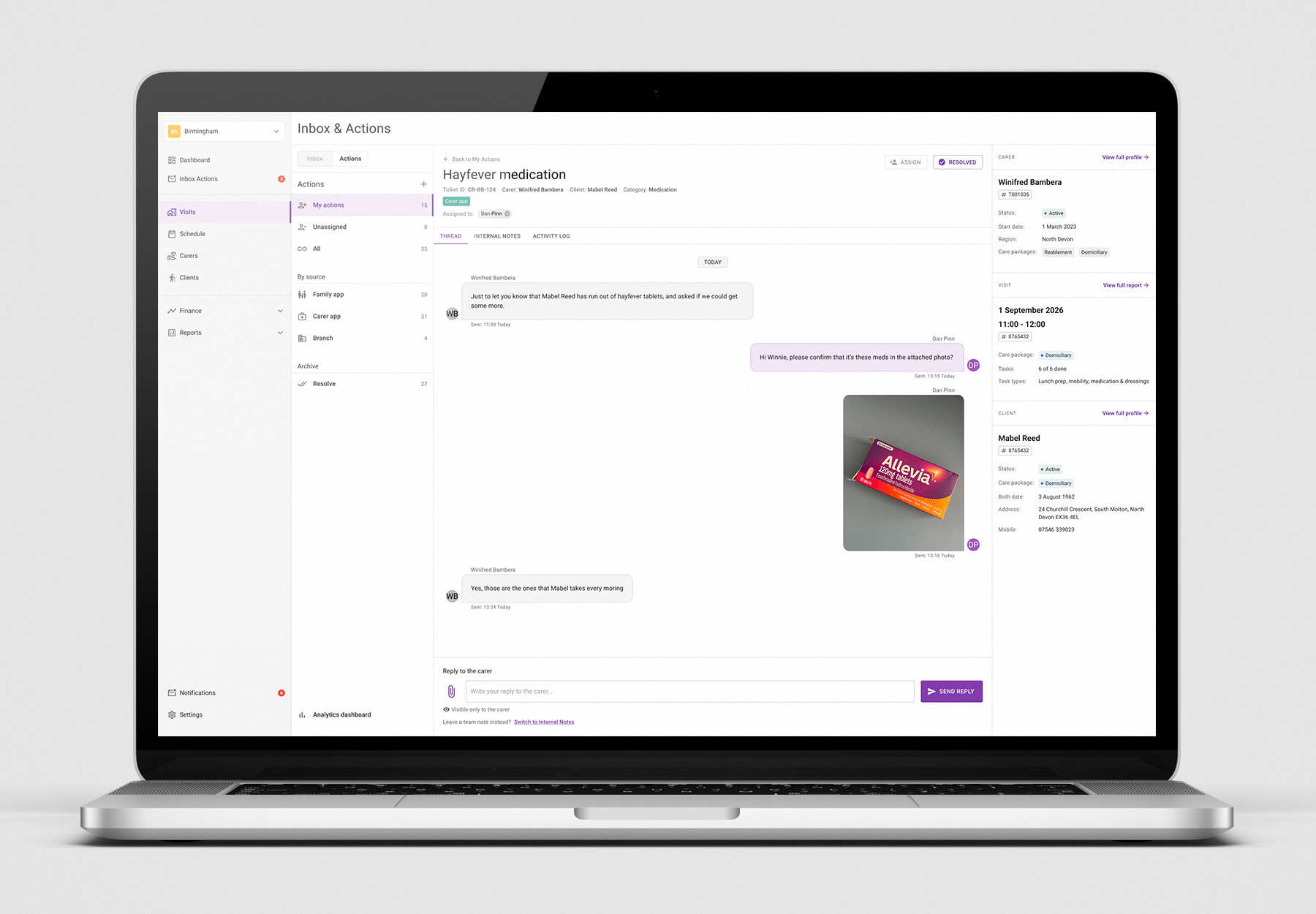
Carers and families could use Ask the branch from within their existing apps, select the reason for their enquiry and send a message. The resulting action appeared directly within DCP where branch staff could triage it, assign ownership, reply, add internal notes and resolve it.
Most importantly, the conversation remained inside Cera.
Carers and families could see both open and resolved requests and continue the conversation without being pushed into email, directly addressing one of the strongest problems identified during research.
For branch teams, requests were no longer isolated from the client record. Every action had context, ownership and an audit trail.
Designing the MVP
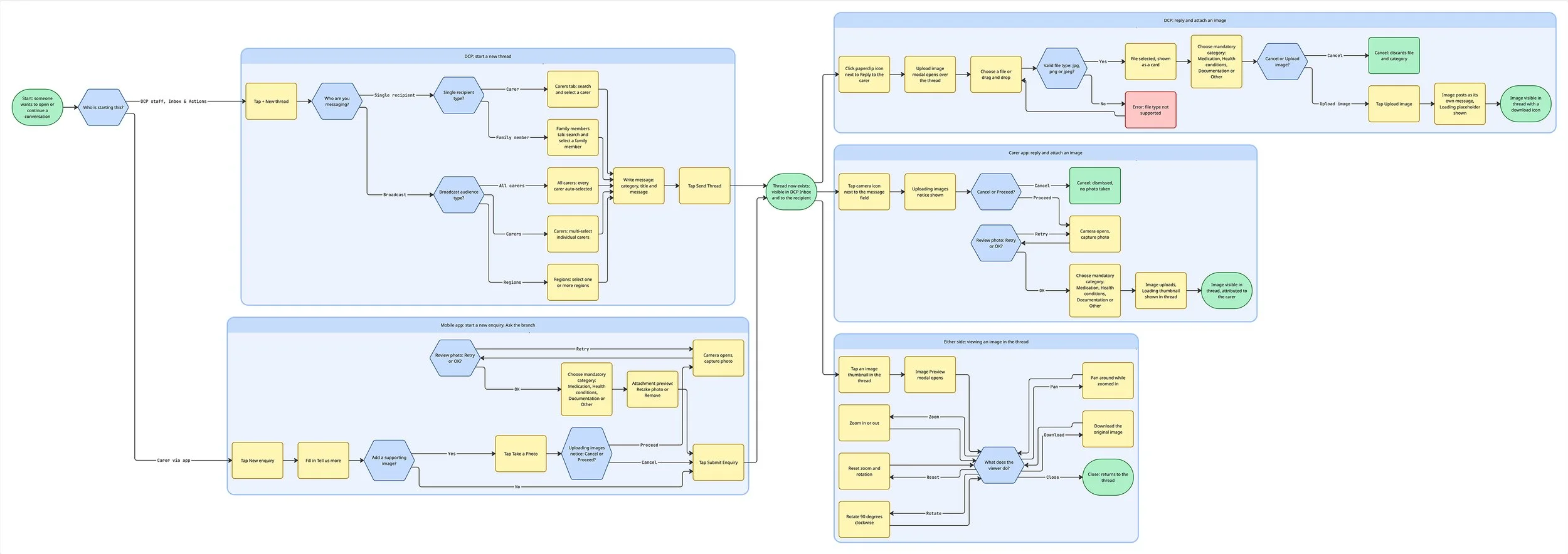
This project also marked an evolution in my design process.
Alongside Figma, Miro, user interviews and close collaboration with Product and Engineering, I used Claude extensively as a design assistant.
I used AI for the work it was good at: helping organise research findings, interrogate requirements, identify edge cases, structure documentation and accelerate repetitive tasks.
That freed up more of my time for the work that needed me: talking to users, understanding their behaviour, challenging assumptions and making design decisions.
I also began using Claude to vibe code interactive prototypes.
Rather than manually creating every possible interaction in Figma, I could take an idea from design into a working prototype quickly, explore more possibilities and put something much more tangible in front of users and stakeholders.
My process became something closer to:
1 Research, 2 Define, 3 Design, 4 Vibe code, 5 Test, 6 Learn, 7 Refine
AI accelerated the loop, but it didn't determine the direction. The research and final design decisions remained mine.
AI-Assisted Design Process
The first release was piloted with Fife & Tayside before being rolled out more widely. This gave us an opportunity to validate the product with people doing the job rather than treating launch as the end of the design process.
Following the MVP launch, I returned to branch staff and carried out another round of extensive interviews.
This time the questions changed.
Rather than asking "Have we suceeded in replacing Freshdesk?", I wanted to understand: What's better? What's worse? What's still missing?
Comparing Inbox & Actions directly with their previous experience helped uncover a new set of needs that wouldn't necessarily have emerged during initial discovery.
Testing the MVP in the Real World
The MVP validated the core concept, but putting it into people's hands quickly showed where the experience needed to go next.
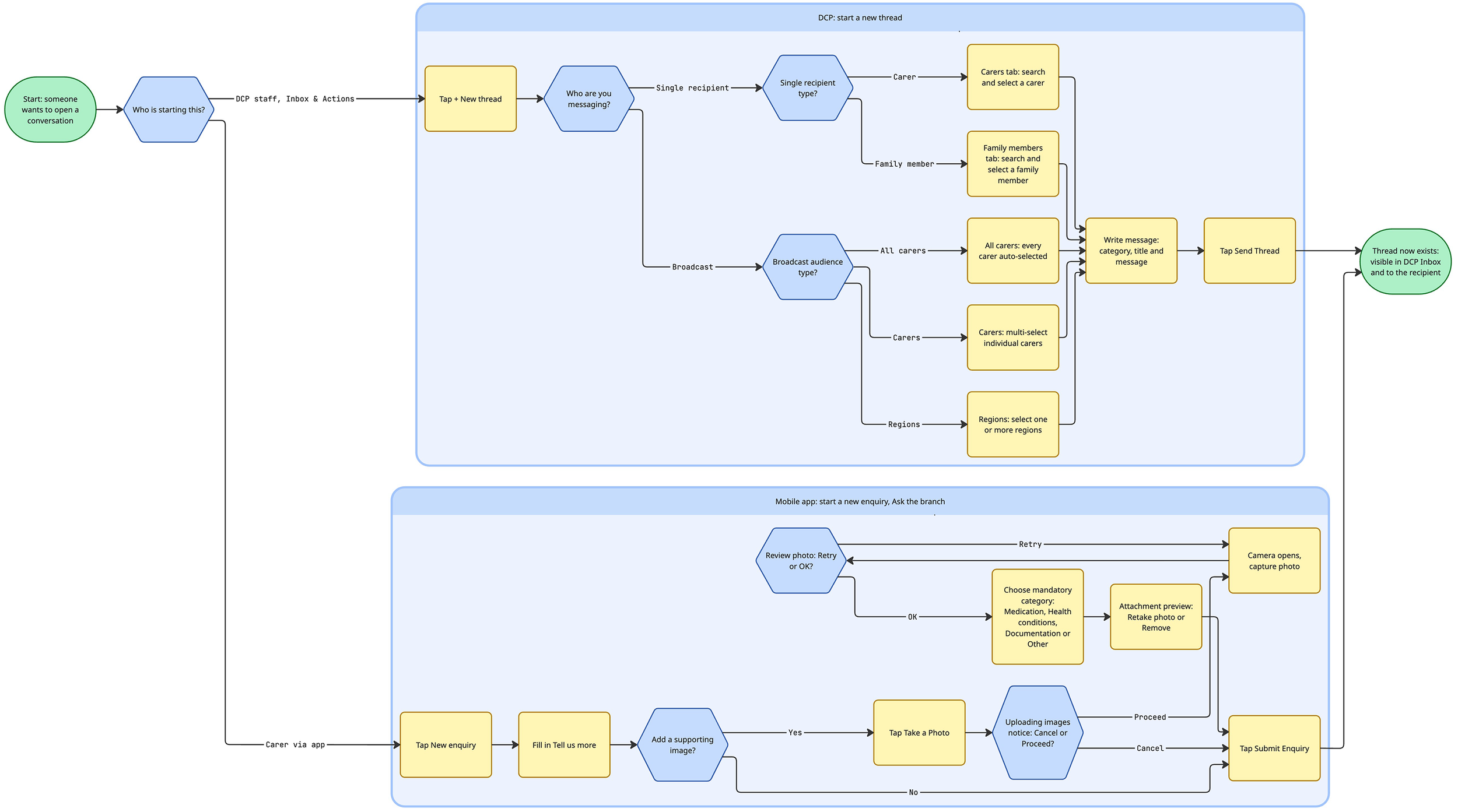
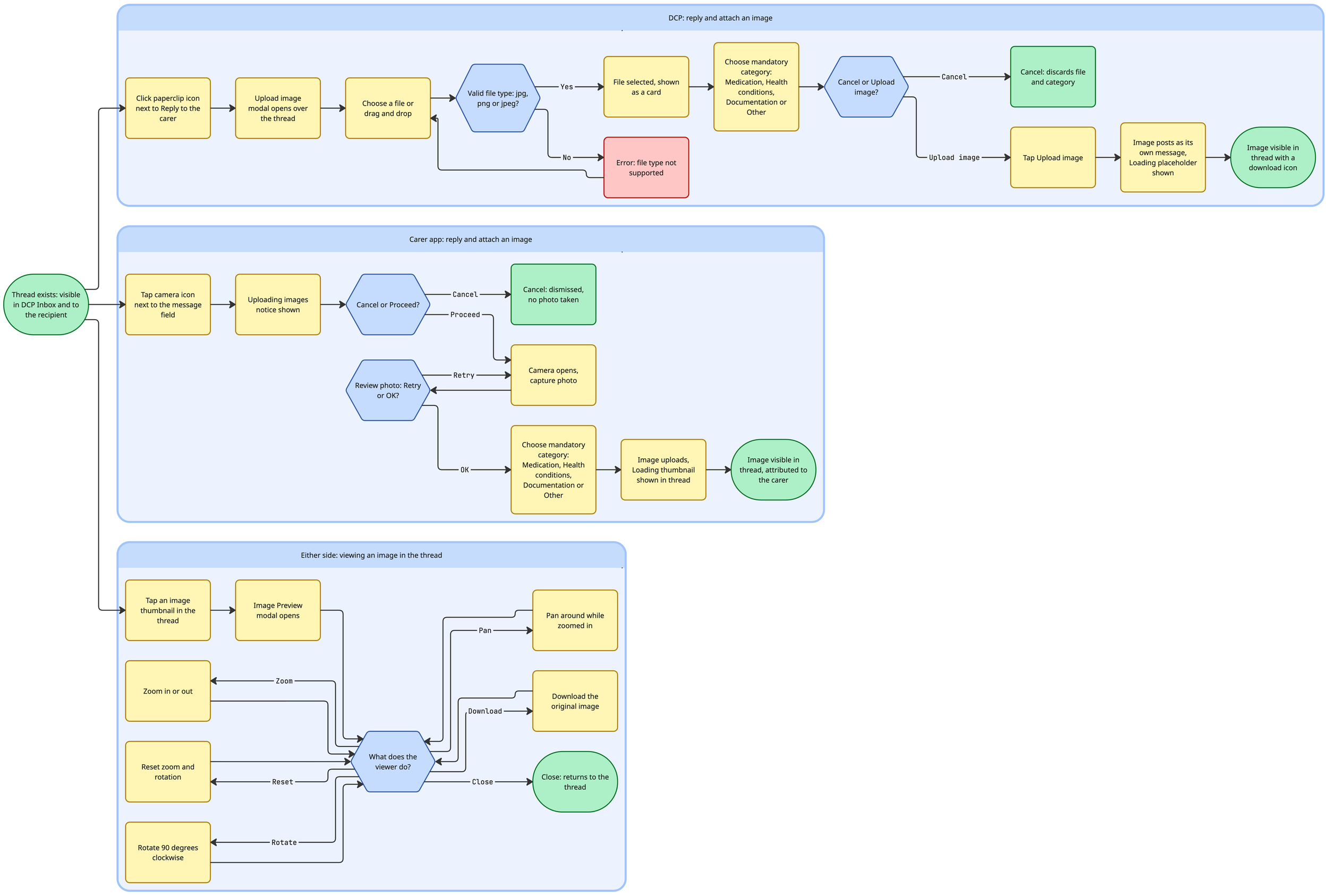
Share more than text: Branch staff needed to send and receive images and documents within an action. Without this, communication could still escape into other channels and break the audit trail. This became particularly important because the legacy chat already supported images, making file sharing an important parity requirement before it could eventually be retired.
Bring colleagues into the conversation: Users wanted @mentions within threads, allowing them to bring another branch team member's attention to a specific action without relying on conversations outside the system.
Let branches start the conversation: The MVP focused on carers and families raising requests for branches to manage. Research showed this only solved half the problem. Branch staff also needed to initiate communication themselves, whether contacting an individual carer, requesting a response or sharing information with a wider group.
This became one of the biggest blockers to eventually retiring Cera's legacy chat.
Capture better information upfront: Free-text fields gave users flexibility, but they also meant branch staff sometimes had to investigate further before they could act. Users wanted more structured information within the Carer and Family Apps, capturing the right details at the point an enquiry was created.
Expand categorisation: The initial categories provided a useful starting point, but real-world usage highlighted the need for a broader and more nuanced set of categories to support triage.
Help me understand what matters first
As Inbox & Actions became busier, users needed help deciding where to focus.
Not every action carried the same urgency.
The next iteration therefore began exploring prioritisation, urgency and response expectations, helping carers understand important messages and giving branches better visibility of time-critical actions.
What We Learned After Launch
These findings shifted the project into its next phase.
Rather than building a long feature list based on assumptions, post-launch research gave us evidence for where the product needed to evolve.
The opportunity expanded from: Replace Freshdesk, to: Create one central place for communication, actions and accountability across Cera.
The next stage explored branch-initiated communication, @mentions, group messaging, richer structured requests, attachments, prioritisation, notifications and stronger audit and reporting capabilities.
The MVP wasn't the finished product.
It gave us something real to learn from.
Continuous Discovery
Inbox & Actions delivered more than a replacement for Freshdesk. It became an important step towards bringing Cera's operational tools into its own Digital Care Platform.
£60k annual saving: Moving away from Freshdesk removed the need for the third-party licence, delivering an annual saving of £60,000.
One place to work: Requests, conversations and actions were brought directly into DCP, giving branch teams a central place to manage communication rather than moving between separate systems.
Less context switching: Removing another third-party tool reduced the amount of switching between systems, directly addressing one of the biggest frustrations uncovered during my initial user research.
A better experience for carers and families: Conversations that started inside the Carer or Family App could now remain there. Users gained visibility of open and resolved requests rather than being pushed into disconnected email conversations. This was one of the core benefits identified for the new experience.
Clearer ownership and accountability: Every action could be assigned, tracked and resolved with its history connected to the relevant client. This gave branch teams clearer ownership while creating a stronger audit trail for the business.
The start of a wider platform: Rather than recreating Freshdesk feature-for-feature, Inbox & Actions created a foundation Cera could build on. Messaging, alerts, tasks and other operational communication could increasingly be brought together within DCP instead of relying on separate third-party products.
More than a Freshdesk replacement. A step towards bringing Cera's operational tools into one connected platform.
Key Impact
This project reinforced two things that have become increasingly important to the way I work.
The first is the value of continuous discovery.
The interviews before launch helped us understand why Freshdesk wasn't working. The interviews afterwards were arguably even more valuable because users now had something tangible to compare it against. Their feedback moved beyond abstract wants and exposed the real gaps in the experience.
The second was how AI could accelerate that process without replacing it.
Using Claude to help organise findings, explore edge cases, document decisions and vibe code interactive prototypes meant I could move from research to something testable much faster.
But the most valuable part of the process was still sitting down with people, understanding how they worked and deciding which problems were worth solving.
AI helped me move faster. Users helped me know where to go.